


You've priced a composite deck, and every quote names the same three brands: Trex, TimberTech and Fiberon. In Seattle, where decks stay wet from October through May, the choice shows up fast: dark mildew in the shade, moss in the gaps, and a warranty with cleaning rules you didn't know about.
We build composite decks across Seattle and the Eastside, so we see how these boards age. Here's how the three brands compare in a Pacific Northwest yard, with links to the manufacturer documents behind every claim.
Key takeaways:
-
There's no single best composite decking brand for Seattle. Shade, budget and how much cleaning you'll do decide it.
-
In wet, shady yards, we lean toward PVC-based lines because they have no wood fiber for mold to feed on. They cost more.
-
Fiberon's Good Life line is priced closer to wood, which makes it the value pick of the three.
-
Read the cleaning rules in the warranty. Trex's stain warranty expects you to clean mold and mildew within one week of seeing it.
-
Installation matters as much as the brand: board gaps, drainage and airflow.
Quick Answer: Which Brand Fits Which Homeowner?
|
Your yard |
Where we'd start |
Why |
|
Shaded, damp, under evergreens |
PVC-based lines: TimberTech AZEK (Harvest, Landmark, Vintage) or Fiberon Promenade and Paramount |
No wood fiber in the core, plus 50-year stain and fade coverage |
|
Sunny or mixed light, good value |
Trex Enhance or Select, or a TimberTech capped composite |
Capped composite at a lower price; plan on cleaning twice a year |
|
Tight budget |
Fiberon Good Life |
Priced closer to wood than most capped composites |
|
Longest coverage on a wood-fiber board |
Trex Transcend or Fiberon Concordia |
50-year stain and fade coverage |
Use this as a starting point, and confirm current warranty terms for the exact line before you sign anything. The sections below explain the reasoning.
What Makes The Pacific Northwest Hard On Decking
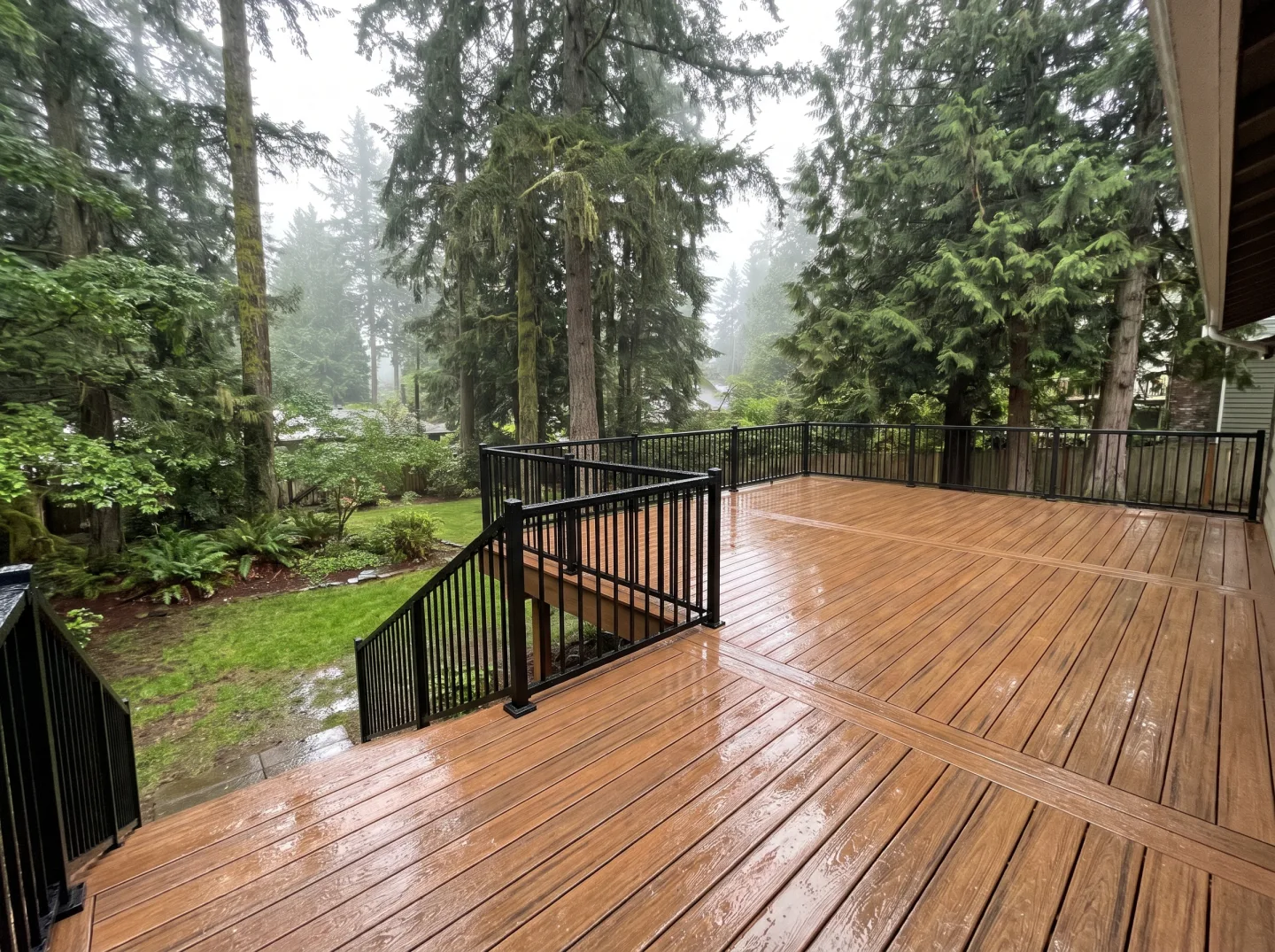
Seattle decks stay wet for most of the year. Add shade from tall evergreens, needles and leaves on the boards, and moss in every gap, and you have a hard environment for any decking.
Composite won't rot like wood, but it can still grow mold. Trex's own technical bulletin explains why: mold needs food, moisture and temperatures between 40 and 90 degrees Fahrenheit. The board isn't the food. Dirt, pollen and debris on it are. The bulletin also warns that board gaps that are too tight or clogged can hold moisture.
That's why we judge a board on three things in this climate:
-
The cap. A full cap around the board keeps water and dirt away from the core.
-
The core. Less wood fiber means less for mold and mildew to feed on.
-
The install. Correct spacing, airflow underneath and good drainage matter as much as the board.
If you're still deciding between composite and wood, start with our guide: Composite vs. Cedar vs. Pressure-Treated Decking: What Lasts in Seattle?
Trex vs. TimberTech: The Comparison Everyone Asks About
Trex and TimberTech are the two names you'll see most often, and they overlap more than their marketing suggests. Both make capped boards, both sell through contractors and big-box stores, and both offer long warranties. The real differences are in the core material and in how each line handles moisture.
Core and cap: what the boards are made of
Trex's best-known lines (Enhance, Select and Transcend) are wood-plastic composites: recycled plastic mixed with wood fibers and wrapped in a protective cap. Trex also sells PVC decking, called Refuge, a limited-launch, ignition-resistant line for fire-prone regions. It isn't a standard option for wet-climate projects, and availability in Seattle may be limited.
TimberTech sells two kinds of boards. Its capped composite collections (Prime+, Prime, Premier, Legacy, Reserve and Terrain) have a wood-and-plastic core. Its AZEK collections (Harvest, Landmark and Vintage) are capped PVC with no wood in the core.
In plain English: if a board has wood fibers inside, the cap is its protection. If a board is PVC all the way through, there's less for mold to feed on. That is a real advantage in shade, though PVC decking usually costs more.
Product lines side by side
|
Trex |
TimberTech |
|
|
Wood-plastic composite |
Enhance, Select, Transcend |
Prime+, Prime, Premier, Legacy, Reserve, Terrain |
|
PVC |
Refuge (limited-launch, ignition-resistant line; regional availability varies) |
AZEK: Harvest, Landmark, Vintage |
|
Typical price tier |
Budget to premium |
Mid-range to premium |
|
Fade and stain warranty |
Enhance 25 years, Select 35, Transcend 50 |
Varies by collection; AZEK PVC lines carry 50 years |
Price tiers come from the Bob Vila review of the best composite decking brands. Actual prices vary by line, color and where you buy, so ask for current quotes.
Warranty: what's actually covered
Both brands give you two kinds of coverage: a structural (product) warranty and a fade and stain warranty. The length depends on the line. Trex lists 25 years for Enhance, 35 for Select and 50 for Transcend in its warranty documents. TimberTech's AZEK PVC collections carry a 50-year limited fade and stain warranty, and its composite collections are covered by a separate fade and stain warranty.
Here's what homeowners should know in Seattle: the cleaning rules are part of the warranty. Trex's stain warranty document expects you to clean food and beverage spills, and any mold or mildew, within one week of exposure or first appearance. In a wet, shaded yard, that's a real commitment. Keep your receipts, your install records and a note of when you cleaned.
How they behave in Seattle conditions
In our experience, any wood-fiber composite will show mildew in a shaded, damp spot if it isn't cleaned. That's true for Trex and for TimberTech's capped composite collections. Washing in spring and fall keeps it manageable.
PVC-based boards tend to stay cleaner in the same conditions because there's no wood fiber in the core. They still collect pollen and dirt, so they still need washing. If your yard stays wet and shaded most of the year, we often suggest them, as long as the budget works. In a bright, open yard, a mid-tier capped composite is usually enough.
You can see how composite performs on a real build in our Bellevue deck rebuild, where two elevated decks on a sloped lot were rebuilt with new frames and composite tops.
Fiberon vs. Trex: Value, Look and Long-Term Ownership
Fiberon vs. Trex is mostly a question of price and appearance. Fiberon sells both PE composite boards (Good Life, Sanctuary and Concordia) and PVC boards (Promenade and Paramount). Bob Vila's brand roundup puts Fiberon's price range lower than Trex's.
Good Life is the line to know. Pro Builder describes it as low-maintenance decking priced closer to wood, with a cap on three sides. Fiberon's warranty registration page lists 25 or 30 years for Good Life, depending on the collection, while its decking lineup shows 50-year stain and fade coverage on Concordia and the PVC lines.
Here's how we see the two side by side:
|
Fiberon |
Trex |
|
|
Price tier |
Budget to mid-range |
Budget to premium |
|
Value line |
Good Life (25 to 30 years) |
Enhance (25 years) |
|
Top composite line |
Concordia (50-year stain and fade) |
Transcend (50 years) |
|
PVC option |
Promenade, Paramount |
Refuge (limited-launch; availability varies by region) |
|
Best for |
Budget-minded buyers who want a natural look |
Buyers who want the widest choice of lines |
We suggest Fiberon when the goal is a good-looking deck at a sensible price and the yard gets decent sun. We suggest Trex when the project is larger, the budget has room, or you want the widest choice of lines. Neither is a wrong answer. The right one is the line that fits your yard and your budget.
TimberTech vs. Fiberon: Is The Premium Look Worth It?
TimberTech vs. Fiberon looks different depending on where you shop in each lineup. At the premium end, both sell PVC boards with 50-year fade and stain coverage: TimberTech's AZEK Landmark and Vintage, and Fiberon's Promenade and Paramount. Here the decision comes down to color, texture, the written price and who will install it.
At the value end, compare TimberTech's capped composite collections with Fiberon's Good Life or Sanctuary. Fiberon prices Good Life closer to wood, so ask whether the extra cost of the TimberTech board buys you anything you'll notice from the patio.
Our honest take: if you'll see the deck from your kitchen every day, spend on the finish you love. If it's a secondary space, a value line looks good for much less. We always look at samples outdoors, because showroom lighting and Seattle's gray skies make boards look very different.
Best Composite Decking Brand for Your Seattle Deck: Our Verdict
There's no single best composite decking brand for every home. Here's how we'd decide:
-
How much shade do you have? More shade and moisture point toward PVC-based lines. An open, sunny yard gives you more freedom.
-
How high is the deck? Elevated, multi-level decks have more exposed edges and often need more robust fascia and railing details.
-
What's your budget? Capped composite costs about 25 to 35 percent more than cedar upfront but needs no sealing, based on our composite vs. cedar comparison.
-
How do you want it to look? Always view samples outdoors.
-
How long will you stay? Warranty length matters more if you plan to stay 20 years or more.
Independent testing doesn't crown one brand either. Consumer Reports runs three-year composite decking tests, though the full article is behind a paywall. A recap of its ratings shows Envision Evergrain at the top of the composites, with specific TimberTech and Fiberon lines also rated well. The takeaway: judge the specific line, not just the logo.
What Composite Decking Really Costs in Seattle
Boards are only part of the price. The frame, footings, hidden fasteners, railings, stairs and permits add up, and in our work the substructure often decides whether a deck lasts 25 years or fails early.
In our 2026 cost guide, a new Seattle-area deck typically runs about $45 to $105 per square foot installed, depending on the material. Composite decking typically runs about $70 to $105 per square foot installed, according to our cost guide. You'll find the full breakdown in How Much Does a Deck Cost in Seattle? 2026 Prices, Permits & Materials Guide. If the total feels high, we also offer financing options.
Installation, Permits And Code in Seattle
A good board can still fail on a poor install. The biggest mistakes we see are gaps that are too tight, debris packed under the boards and poor drainage below the deck. Trex's technical bulletin makes the same point: small or clogged gaps can hold moisture. Follow the manufacturer's gapping and fastener instructions, because they're also a condition of the warranty.
Seattle requires a permit for a deck that is more than 18 inches above the ground, a roof deck, or a deck in an environmentally critical area (ECA). Most need only a subject-to-field-inspection permit, but decks more than 8 feet up, or in an ECA, may need a full addition or alteration permit, according to SDCI's deck page. We handle permits and code details on our builds. You can see how we work on our process page and our deck building service page.
Caring for Composite Decking in a Wet Climate
Composite is low-maintenance, not no-maintenance. Here's what we recommend:
-
Sweep leaves and needles regularly, especially in fall.
-
Wash the deck in spring and again in fall with soap and water, following your manufacturer's instructions.
-
Clean mold and mildew as soon as you see it. Trex's stain warranty expects it within one week.
-
Keep downspouts and planters from draining onto the boards.
-
Skip harsh tools, and keep pressure washing within the manufacturer's limits. Follow the brand's care guide, such as Trex's care and cleaning page.
The frame and railings under and around a composite deck are often wood, and they still need protection from moisture. Our deck sealing and waterproofing service covers that. If your current composite deck has damaged boards or framing, we can look at deck repair first, because replacement isn't always necessary.
Choose The Best Decking for Your Home and Budget
The best composite decking brand is the one that fits your yard, your budget and how long you plan to stay. Shade and moisture should drive the choice between Trex and TimberTech. Price and finish usually decide the rest.
Choosing between cedar and composite, or between two composite lines? We can bring material samples to your home and explain your options. Want an accurate project estimate? We'll assess your property and provide a written breakdown. Book a free estimate.
Craft Boys is a family-owned deck builder serving Bellevue, Redmond, Kirkland and the rest of Seattle and the Eastside, with 12+ years of construction experience, 300+ decks built and restored, and a 10-year workmanship warranty.
FAQ
Is Trex or TimberTech better for rainy climates?
For wet, shaded yards, we lean toward PVC-based lines such as TimberTech's AZEK collections, because they have no wood fiber in the core. In sunnier yards, a capped composite from either brand is usually good value. With either one, regular cleaning and a proper install matter as much as the logo.
Does composite decking get moldy in Seattle?
It can. According to Trex's technical bulletin, mold feeds on dirt, pollen and debris and needs moisture to grow. Shaded, damp areas are the most likely to show it. Regular cleaning and good drainage keep it in check.
How long does composite decking last in the Pacific Northwest?
Most major brands offer warranties from 25 to 50 years, depending on the line. Real-world life depends on installation, sun and shade, and how well you maintain it. Warranty length is not a guarantee of lifespan.
Is Fiberon as good as Trex?
Both are established brands with capped boards and long warranties on their upper lines. Fiberon usually costs less, and Trex offers more lines. Compare specific lines and their warranty terms, not just brand names.
Do I need a permit to replace decking boards in Seattle?
SDCI's deck page covers building decks: a permit is required above 18 inches, for roof decks and in environmentally critical areas. It doesn't spell out replacing boards on an existing deck, so check with SDCI before you start, or ask us and we'll tell you what applies to your project.